
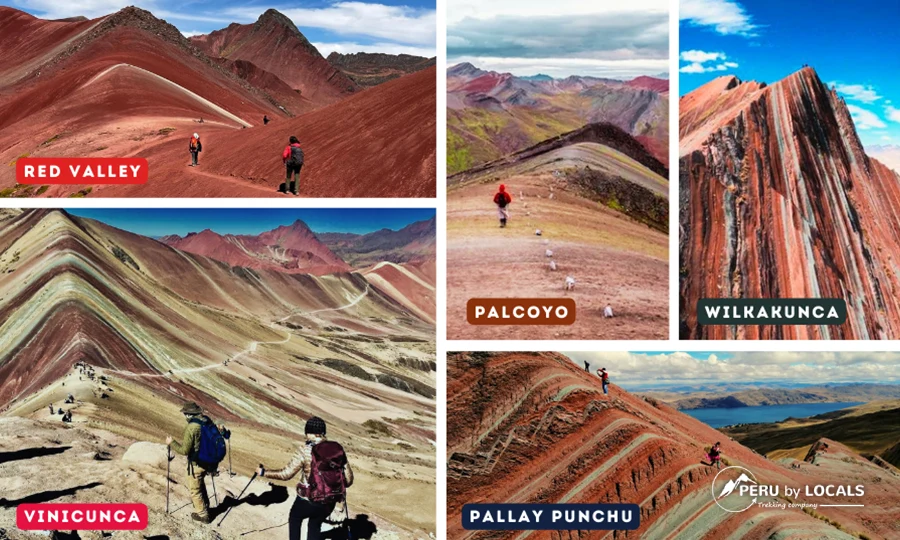
If you are an adventure seeker and nature lover, the Rainbow Mountains in Cusco offer an extraordinary visual spectacle found almost nowhere else on Earth. While millions know of Vinicunca, the Cusco region is actually home to five distinct colorful mountain formations: Vinicunca, Palcoyo, Pallay Punchu, the Red Valley, and Wilkakunca. Each offers a unique geological story, varying difficulty levels, and breathtaking Andean backdrops.
The mesmerizing stripes are millions of years of marine and fluvial sedimentary deposits. Tectonic uplift folded these layers vertically, exposing rich veins of iron oxide (red/pink), copper carbonate (green), and sulfurous limonites (mustard yellow).
- How Many Colorful Mountains Are There in Cusco?
- 1. Vinicunca - The World-Famous Rainbow Mountain
- 2. Palcoyo - The Tranquil & Accessible Alternative
- 3. Pallay Punchu - The Jagged Poncho Mountain
- 4. The Red Valley (Valle Rojo) in Pitumarca
- 5. Wilkakunca - The Mountain of Love
- Why Do the Mountains Have These Vivid Colors?
- Comparative Table of Colors & Characteristics
- Frequently Asked Questions
Jose Condor's Guide: If you are physically active and want the classic bucket-list photo overlooking the sharp 5,200m crest, hike Vinicunca (and don't miss adding the Red Valley!). If you are traveling with children, seniors, or want a gentle 45-minute stroll with three distinct rainbow mountains and virtually zero crowds, Palcoyo is by far the superior choice.
How Many Colorful Mountains Are There in Cusco?
One of the most frequent questions from travelers is how many rainbow mountains actually exist in the Cusco department. Currently, five distinct colorful mountains are accessible to hikers. Each destination features unique topography, altitude, walking times, and color intensities. Let us explore each one in detail.
1. Vinicunca - The World-Famous Rainbow Mountain
Perched at an imposing 5,200 meters (17,060 feet) above sea level, Vinicunca is the crown jewel and most famous colorful mountain in South America. Situated in the shadow of Sacred Mount Ausangate, its striking mineral ribbons make it one of the most photographed wonders on the planet.
Mineral Colors of Vinicunca
| Color Tone | Mineral Composition & Geological Layer |
|---|---|
| Pink / Fuchsia | Red clay (mudstone) and sandstones from the Cretaceous period |
| Whitish / Cream | Quartzose sandstone, limestone, and calcium carbonates |
| Purple / Lavender | Claystone mixed with oxidized silicates and magnesium compounds |
| Brick Red | Ferruginous clays (iron oxide / hematite) from the Tertiary period |
| Green / Turquoise | Phyllites and copper-rich chlorite clays with trace minerals |
| Mustard Yellow / Gold | Calcareous sandstones enriched with sulfurous limonites |
How to Reach Vinicunca
Vinicunca is accessed via two trailheads: Cusipata (the most common route, approx. 1.5 to 2 hours hiking one way) or Pitumarca. Due to the high altitude, booking an experienced local agency with oxygen and emergency protocols is essential. Reserve our Rainbow Mountain Full Day Hike or compare what to carry in our Rainbow Mountain Packing List.
2. Palcoyo - The Tranquil & Accessible Alternative
If you want to experience the rainbow hues without the strenuous high-altitude uphill climb of Vinicunca, Palcoyo is the premier alternative. Palcoyo actually features three separate rainbow mountains visible simultaneously, framed by a spectacular prehistoric Stone Forest (Bosque de Piedras).
Colors of Palcoyo
| Color Tone | Visual Characteristics |
|---|---|
| Vibrant Red | Dominates the expansive valley ridges |
| Warm Mustard | Prominent throughout the middle strata |
| Earthy Green | Blends harmoniously between red and yellow bands |
| Turquoise & Purple | Subtle pastel hues accentuating upper viewing ridges |
Hike Difficulty: Very easy. The walk from the vehicle parking area takes only 30 to 45 minutes along a gentle ridgeline with minimal elevation change. It is ideal for families, seniors, or travelers with limited acclimatization time.
3. Pallay Punchu - The Jagged Poncho Mountain
Discovered and popularized during 2020, Pallay Punchu (located in the Canas province near Layo) is famed for its sharp, jagged knife-edge ridges that resemble the intricate geometric patterns of a traditional Andean woven poncho (pallay).
Colors of Pallay Punchu
| Color Tone | Description |
|---|---|
| Deep Crimson Red | Intense, razor-sharp geometric stripes |
| Pastel Pink | Visible at upper ridge precipices |
| Deep Violet | Stunning contrast against the deep blue waters of Lake Langui-Layo below |
| Moss Green & White | Lower bands framing the sharp peaks |
How to Get There: Drive southeast from Cusco past Sicuani to the picturesque shores of Lake Langui in Layo. The hike takes roughly 45 to 60 minutes uphill to the sharp crest.
4. The Red Valley (Valle Rojo) in Pitumarca
Located right behind Vinicunca, the Red Valley (Valle Rojo) looks like a scene transported from Mars. The entire landscape consists of striking, terracotta-red rolling mountains intersected by green alpine mosses and occasional turquoise glacial runoff streams.
Trekking Tip: It is easily combined with the Vinicunca Rainbow Mountain Hike as an extended scenic loop that avoids retracing the same trail.
5. Wilkakunca - The Mountain of Love
The newest addition to Cusco's colorful mountain circuits is Wilkakunca, affectionately known locally as La Montaña del Amor (The Mountain of Love). Due to its seclusion, it receives virtually zero mass tourism, offering pure tranquility, native alpaca herds, and untouched rainbow-striped hills.
Why Do the Mountains Have These Vivid Colors?
The spectacular coloration of Cusco's mountains is the result of over 65 million years of complex marine and volcanic sedimentary history. During the Mesozoic and Tertiary eras, heavy sediment saturated with diverse mineral compounds settled in low-lying basins.
When the South American and Nazca continental plates collided, the resulting tectonic collision pushed the Andes upward, bending horizontal layers into near-vertical bands. Hundreds of thousands of years of glacial weathering, wind erosion, and atmospheric oxidation revealed the brilliant spectrum of colors we marvel at today.
Comparative Table of Colors & Characteristics
| Mountain | Elevation | Difficulty | Predominant Mineral Tones | Best For |
|---|---|---|---|---|
| Vinicunca | 5,200 m (17,060 ft) | Moderate to Challenging | Pink, white, purple, red, green, mustard yellow | Iconic, classic bucket-list views |
| Palcoyo | 4,900 m (16,076 ft) | Easy (30–45 min walk) | Red, mustard yellow, green, white, turquoise | Families, less walking, tranquil experience |
| Pallay Punchu | 4,790 m (15,715 ft) | Moderate | Intense red, magenta, violet, white | Dramatic jagged ridgelines & lake views |
| Red Valley | 5,050 m (16,568 ft) | Moderate | Deep brick red, bright green mosses | Mars-like landscapes; add-on to Vinicunca |
| Wilkakunca | 4,800 m (15,748 ft) | Moderate | Red, yellow, olive green, white | Secluded off-the-beaten-path exploration |
Frequently Asked Questions About Cusco's Rainbow Mountains
Vinicunca is famous for its classic steep triangular peak and Red Valley view, but requires a strenuous hike at 5,038 meters with hundreds of daily tourists. Palcoyo offers an easier 45-minute gentle walk, 3 distinct rainbow ridges, a stone forest, and significantly fewer crowds.
The colors are caused by millions of years of weathering and mineral sediment layers: iron oxide produces red, phyllites and clays create green, sulfur forms yellow, and calcium carbonate creates bright white.
Whether you select the worldwide fame of Vinicunca, the gentle solitude of Palcoyo, or the sharp ridges of Pallay Punchu, exploring Cusco's rainbow peaks is an unforgettable journey into the heart of the Andes. For an intimate multi-day wilderness experience combining these peaks with authentic Incan pack animals, check out our Llama Trek in Peru and prepare with our Rainbow Mountain Packing List!


